
2026/09/09
What Materials Are Best for Automotive Seals in High-Temperature Conditions?


O-rings for semiconductor equipment must meet more demanding requirements than conventional industrial seals. In semiconductor manufacturing, even small amounts of particles, chemical contamination, or unwanted gas release can affect process stability and wafer quality. Choosing the right semiconductor O-ring manufacturer is therefore important for equipment builders seeking reliable sealing performance in cleanroom and high-purity environments.
From wafer processing and chemical delivery to vacuum chambers and thermal equipment, rubber seals must withstand specific combinations of temperature, pressure, chemicals, and cleaning conditions. Material selection alone is not enough. Surface quality, manufacturing consistency, packaging, and contamination control also play important roles.
This article examines the key material requirements and cleanroom sealing challenges that engineers and procurement teams should consider when selecting O-rings for semiconductor equipment.
Semiconductor manufacturing involves highly controlled processes in which small variations can affect production results.
O-rings are commonly installed in equipment interfaces where liquids, gases, vacuum, or process chemicals need to remain contained. Typical applications include:
Vacuum chamber doors and access ports
Chemical delivery systems
Wet etching and wafer cleaning equipment
Chemical mechanical polishing (CMP) systems
Chemical vapor deposition (CVD) equipment
Plasma processing chambers
Thermal processing and diffusion equipment
Gas and fluid connection assemblies
In these applications, an O-ring must maintain a stable sealing barrier without introducing unwanted contamination into the process environment.
For example, a seal used in a chemical delivery system must remain compatible with the actual process fluid. An O-ring installed in a vacuum chamber may also need low outgassing characteristics to avoid affecting chamber conditions.
This makes semiconductor sealing a combination of material engineering, process compatibility, and manufacturing quality control.
Different semiconductor processes expose sealing components to different operating conditions. Selecting an appropriate elastomer requires understanding the chemicals, temperature, pressure, and cleaning procedures involved.
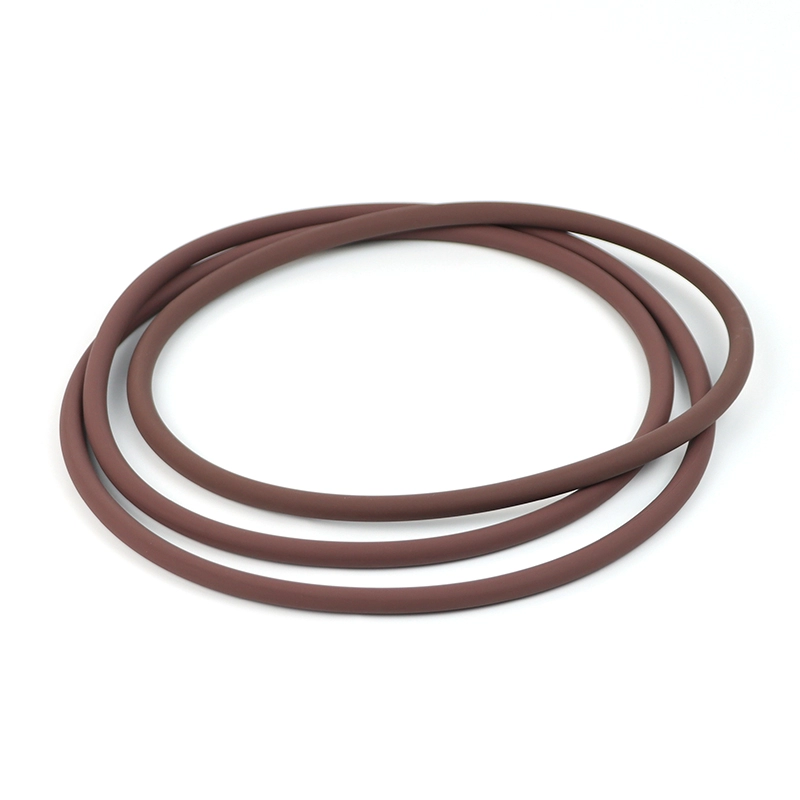
FFKM (Perfluoroelastomer) is widely considered for demanding semiconductor sealing applications because of its broad chemical resistance and ability to withstand elevated temperatures in suitable formulations.
It is commonly evaluated for:
Wet chemical processing
Plasma processing equipment
Chemical vapor deposition systems
Aggressive cleaning and etching environments
High-temperature process equipment
Its resistance to many aggressive chemicals can help reduce seal degradation and the risk of contamination caused by material deterioration.
However, not all FFKM compounds have identical properties. Engineers should verify the exact compound's compatibility with the process chemicals, temperature cycles, plasma exposure, and expected service conditions.
FKM (Fluorocarbon Rubber) offers good resistance to many oils, fuels, and chemicals, along with useful heat resistance.
It can be considered for selected semiconductor equipment applications where the actual chemical environment and temperature fall within the compound's operating limits.
However, standard FKM should not automatically be treated as interchangeable with FFKM. Their chemical resistance and suitability for aggressive semiconductor processes can differ significantly.
EPDM offers good resistance to water, ozone, and weathering. Depending on the formulation, it can be suitable for selected water-based utility systems and equipment interfaces.
Its compatibility with individual cleaning chemicals and process fluids must be checked before use.
Silicone rubber offers good flexibility across a wide temperature range and is used in various industrial and electronic applications.
However, semiconductor equipment designers should carefully evaluate its outgassing, extractables, and mechanical properties before using it in sensitive process areas.
NBR provides good resistance to many petroleum-based oils and fuels. It may be suitable for certain auxiliary equipment and general industrial connections where chemical and cleanliness requirements permit.
It is not a universal replacement for high-purity FKM or FFKM sealing components.
Material | Potential Semiconductor Applications | Main Selection Consideration |
FFKM | Wet processing, plasma, CVD, aggressive chemical systems | Compound-specific chemical and thermal resistance |
FKM | Selected equipment interfaces and compatible fluid systems | Actual chemical compatibility and temperature |
EPDM | Suitable water-based utility systems | Water and cleaning chemical compatibility |
Silicone | Selected temperature-sensitive assemblies | Outgassing, extractables, and mechanical properties |
NBR | Auxiliary equipment and compatible oil systems | Fluid compatibility and contamination requirements |
The correct choice should always be based on the actual process conditions rather than the material name alone.
One of the biggest differences between conventional industrial sealing and semiconductor sealing is contamination control.
An O-ring may maintain an effective mechanical seal but still be unsuitable for a sensitive semiconductor process if it releases unwanted substances or introduces particles.
Several factors deserve particular attention.
Particles can originate from damaged rubber surfaces, excessive friction, improper installation, or material deterioration.
In a cleanroom environment, particles may migrate into sensitive equipment areas and interfere with manufacturing processes.
To reduce this risk, engineers should consider material wear characteristics, seal movement, contact surfaces, and the expected maintenance cycle.
Outgassing refers to the release of gases or volatile compounds from a material under specific environmental conditions.
It is especially relevant in vacuum systems and process chambers where unwanted gas release may affect chamber pressure, process stability, or contamination levels.
The outgassing performance of an elastomer depends on its formulation, manufacturing process, cleaning history, and operating conditions.
For critical vacuum applications, material qualification should include appropriate outgassing testing rather than relying only on general material descriptions.
Extractables are substances that can be released from a material when exposed to specific solvents, chemicals, or environmental conditions.
In semiconductor processes, these substances may create contamination concerns if they enter process fluids or contact sensitive surfaces.
Engineers should evaluate the complete material formulation and its compatibility with the actual process media.
Cracks, rough surfaces, swelling, and chemical deterioration can increase particle generation and compromise sealing performance.
A seal that looks acceptable during initial installation may deteriorate after repeated chemical exposure or thermal cycling.
For this reason, inspection and replacement intervals should be based on real equipment conditions and material qualification results.
There is no single O-ring material suitable for every semiconductor manufacturing process.
The required sealing properties depend on the equipment location and the materials it encounters.
Wet Etching and Wafer Cleaning
Wet processes may involve chemicals such as hydrofluoric acid, sulfuric acid mixtures, hydrogen peroxide, and alkaline cleaning solutions.
The O-ring must resist the actual chemical concentration, temperature, and exposure duration. FFKM compounds are frequently evaluated for particularly demanding chemical environments.
Chemical Mechanical Polishing (CMP)
CMP equipment combines chemical exposure with mechanical processing. Seals may encounter slurry, cleaning agents, and repeated equipment cycles.
Material compatibility, abrasion exposure, and the possibility of contamination from seal deterioration should all be considered.
CVD and ALD Equipment
Chemical vapor deposition and atomic layer deposition systems may expose seals to elevated temperatures, reactive gases, and process by-products.
The material must be selected according to the exact gas composition, temperature, vacuum conditions, and seal position.
Plasma Processing
Plasma environments can be particularly challenging because reactive species may attack elastomer surfaces.
The suitability of an O-ring depends on the plasma chemistry, direct or indirect exposure, temperature, and material formulation.
Vacuum Systems
Vacuum chamber seals must maintain leak tightness while limiting unwanted gas release.
For these applications, engineers should consider outgassing characteristics, compression behavior, surface condition, and vacuum compatibility.
Choosing a suitable elastomer is only part of the process. Manufacturing consistency and product handling are equally important when supplying seals for semiconductor equipment.
Several production and handling factors should be considered.
Compound consistency: Variations in raw material formulation can affect chemical resistance, hardness, and mechanical performance.
Molding quality: Flash, surface defects, incomplete curing, and dimensional variations can affect the sealing interface.
Post-curing requirements: Some elastomer formulations may require controlled post-curing to achieve their specified properties. The process should follow the compound manufacturer's recommendations.
Cleaning procedures: Cleaning methods should be compatible with the elastomer and the intended application. An unsuitable cleaning agent may damage the seal or leave unwanted residues.
Packaging and handling: Clean packaging helps prevent dust, particles, and handling contamination during storage and transportation. Individual packaging may be appropriate for selected high-purity applications.
Batch traceability: Production records and material identification can help equipment manufacturers investigate problems and maintain consistent incoming inspection procedures.
It is important to distinguish between a clean-looking product and a qualified cleanroom sealing component. Specific cleanliness, particle, and outgassing requirements should be confirmed through documented specifications and testing.
For semiconductor equipment manufacturers, selecting an O-ring supplier involves more than checking dimensions and material availability.
A suitable manufacturing partner should understand the application and be able to evaluate technical requirements before production.
When assessing a China O-ring manufacturer, consider the following:
Material options: Check whether the supplier can provide NBR, EPDM, Silicone, FKM, and FFKM for different equipment requirements.
Custom dimensions: Semiconductor equipment may require non-standard sizes, special cross-sections, or drawing-based manufacturing.
Technical communication: The manufacturer should be able to review drawings, operating conditions, process media, and material specifications.
Dimensional inspection: Consistent cross-section, inside diameter, and molding quality are essential for reliable assembly.
Quality documentation: Request relevant material data, inspection records, and application-specific test information when required.
Packaging control: Confirm whether the supplier can meet the packaging and handling requirements of the intended equipment application.
Hao Seal Technology Co., Ltd. provides precision-engineered rubber O-rings for industrial and semiconductor equipment applications. Its material options include NBR, EPDM, Silicone, FKM, and FFKM, supporting different requirements involving oils, fuels, water, chemicals, and elevated temperatures.
The company offers both standard and customized O-ring solutions, helping customers match seal dimensions and elastomer selection to specific equipment designs.
Its product range includes sealing components for semiconductor equipment, photovoltaic machinery, hydraulic and pneumatic systems, automotive and new energy vehicles, and other industrial applications.
For customers sourcing rubber O-rings from a China manufacturer, Hao Seal Technology provides multiple material options and customized manufacturing support for different sealing requirements.
Before requesting a quotation or starting a custom sealing project, prepare the following information:
Information | Why It Matters |
Process application | Identifies the actual equipment environment |
Chemical name and concentration | Determines material compatibility |
Operating and peak temperature | Helps evaluate thermal performance |
Operating pressure or vacuum level | Determines sealing requirements |
O-ring dimensions | Ensures compatibility with the equipment groove |
Material and hardness | Defines mechanical and chemical properties |
Cleanliness requirements | Determines handling and packaging expectations |
Expected service life | Helps establish qualification and replacement criteria |
Providing this information early helps reduce unnecessary sample changes and makes technical evaluation more efficient.
O-rings used in semiconductor equipment must satisfy requirements that extend beyond ordinary leak prevention. Chemical compatibility, thermal stability, outgassing, extractables, particle generation, and manufacturing cleanliness all influence sealing reliability.
FFKM is an important option for demanding semiconductor processes, while FKM, EPDM, Silicone, and NBR may also be appropriate for selected applications depending on the actual operating environment.
Hao Seal Technology Co., Ltd. supplies standard and customized rubber O-rings in multiple elastomer materials, supporting industrial and semiconductor equipment manufacturers with application-oriented sealing components.
By combining appropriate material selection, dimensional accuracy, controlled manufacturing, and suitable packaging, equipment manufacturers can build more reliable sealing systems for demanding semiconductor production environments.